Star Cluster in Nearby Galaxies
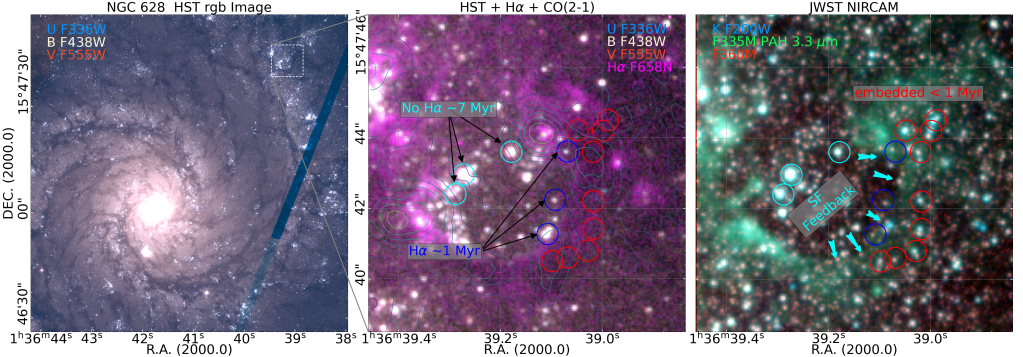
In my current research, I focus on star clusters in nearby galaxies. I am especially interested in large catalogs of star clusters identified with sub arc second resolution using the Hubble Space Telescope (HST) and the James Webb space Telescope (JWST). As a member of the PHANGS team, I work with the PHANGS-HST and PHANGS-JWST treasury program consisting of 38 and 19 nearby galaxies respectively.
The basic idea of studying star clusters is that one can view individual star clusters as time capsules containing information on the physical properties of past star-formation sites. They trace the densest peaks of the overall star formation hierarchy, and are formed from the collapse of clumps within giant molecular clouds. As quasi single-age populations, star clusters have great utility as “clocks” to time various processes in the star formation cycle. My work with star clusters ranges from the very young clusters which can be only seen with the JWST since they are still covered by dust in their natal cloud to the very old globular clusters which formed around 13 Gyr ago.
Double-peak emission line galaxies in the SDSS
A minor merger sequence
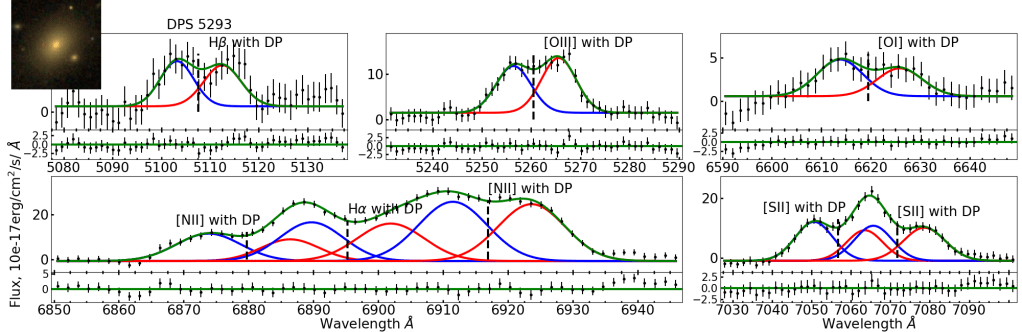
In order to explore late stages of galaxy mergers various searches have been performed to find double-peak (DP) emission line galaxies as such candidates (Wang et al. 2009, Liu et al. 2010 and Smith et al. 2010). However, all these studies were focused on detecting dual AGNs and relied on a visual inspection of the spectra at some points.
Studies using high resolution observations found a connection between DP emission lines and galaxy mergers (e.g. Comerford et al. 2018) but were still focused on AGNs.
To approach the phenomena of DP galaxies from a more general perspective, I developed several detection algorithms to assemble a catalogue in Maschmann et al. (2020) containing 5663 galaxies exhibiting a double-peaked emission line in the 3″ SDSS spectra. In comparison to other studies, this search is not restricted to special galaxy types and does not require any visual selection of the detected galaxies.
My personal contribution to this project was the development of all detection algorithms, all the analyses and their scientific visualisation. I, furthermore, wrote the complete paper which was later reviewed by my collaborators.
We were able to find arguments to connect the detection of a double-peak and a proposed minor merger scenario of multiple, sequential minor mergers, as shown by Bournaud et al. (2007). Our main arguments are that we detect a significant excess of lenticular and bulge dominated galaxies for double peak galaxies and significantly larger gas and stellar velocities which cannot be explained by a rotating disk. This Catalogue is till today the basis of more detailed studies on DP galaxies and peculiar sub samples.
Molecular gas in double-peak emission line galaxies
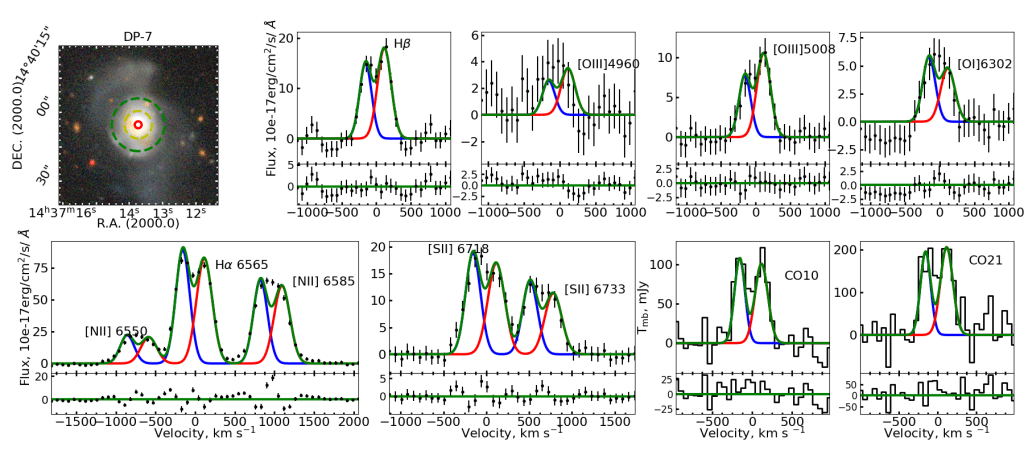
To further probe a minor merger scenario in DP galaxies, I proposed two observational runs with the IRAM 30m Telescope and was awarded with in total 11 nights of observation time. I observed 70 DP galaxies in 2020 and was able to conduct multiple analyses on the origin of the observed DP structure. I combined new observations and archive data of DP galaxies and found the same kinematic signature in the SDSS 3″ spectroscopic observations and the 23″ IRAM 30m observations. We were able to conclude that the gas is most likely concentrated in the centre and is responsible for an observed central star-burst. Furthermore, the absence of strong AGN activity and their classification as above main-sequence galaxies are in good agreement with the concept of compaction episodes due to minor merger as described by Tacchella et al. (2016). I was autonomously working on the observing process, the data reduction, the conduction of the analysis and the redaction of the paper. Besides making a contribution to the subject of galaxy growth in the past 8 billion years, my analysis also provides a clear identification method of multiple gas components from just one single dish observations. This can be used as a strong argument for future proposals for high spatial resolution observation of the molecular and ionised gas.
Combined Fit Method at the Pierre Auger Observatory
Master thesis in Astroparticle Physics and Cosmology at the RWTH Aachen University, Germany
In my master thesis I developed a combined fit method to the energy and shower depth pattern of ultra high energy cosmic rays. In contrast to previous works a cosmic ray point source was added over a homogeneous background in order to resolve the distance and flux contribution of this source. A statistical fitting procedure based on a Markov Chain Monte Carlo method was implemented to investigate in source parameters. The new fit method was tested with a Monte Carlo study of random universes following a fixed source density describing a distinguished direction of the closest source. Here, I was able to determine the same constraints found by previous works on the combined fit, forming a reliable basis for new results.
It is found that the extended combined fit method can resolve the distance of a nearby source and distinguish between a scenario of sky regions exhibiting a nearby source (on-target) and an homogeneous background (off-target). Using a Monte Carlo study I concluded, if the nature follows the physical motivated model, the fit method is able to identify a point source in a sky region and disfavor a homogeneous background with a median p-value of 2×10⁻³ by using the energy and shower depth pattern.
More software packages are coming soon
 Daniel Maschmann